
 DatabendLabs
Immersive Translate is a popular bilingual translation extension used to translate web pages, PDF documents, ePub books, subtitles, and more. The product supports a wide range of translation providers, including Google, OpenAI, DeepL, Microsoft, Gemini, Claude, and others, giving users the flexibility to choose the service that best fits their workflow.
As the product grew, the team needed a better way to understand product usage, performance, and growth trends. The challenge was to build a practical analytics stack that stayed simple, cost-efficient, and flexible enough for a fast-moving product team.
The Challenge: Product Analytics Without Heavy Infrastructure
For a fast-growing product, analytics data quickly becomes one of the most important sources of feedback. Teams need to answer questions such as:
-
Which features are being used most often?
-
Where do translation errors happen?
-
How does latency change across providers or usage patterns?
-
What product signals can help guide future growth?
A typical analytics platform can provide predefined dashboards for page views, funnels, and retention. That is useful early on, but Immersive Translate soon ran into several limitations.
First, the team needed access to event-level details, not only aggregated reports in a UI.
Second, they needed SQL-based ad hoc analysis. Product, engineering, and data teams often need to ask new questions that cannot be fully anticipated in advance.
Third, cost became harder to predict as traffic increased. Many analytics tools use tiered pricing models, where cost can rise sharply once usage crosses a threshold.
With a large global customer base, the team also needed fine-grained control over how analytics data was collected, stored, queried, and potentially deployed across regions in the future.
Why Not Build a Traditional Big Data Stack?
One option was to build a conventional analytics pipeline with Kafka, Spark, Hive, Airflow, and a data warehouse.
That architecture is powerful, but it comes with a heavy operational footprint:
-
Kafka often requires ZooKeeper and careful disk planning.
-
Kafka-to-warehouse pipelines require connectors and maintenance.
-
Spark typically needs a resource manager such as YARN.
-
ETL workflows require scheduling and orchestration.
-
Storage growth can introduce additional system migrations and complexity.
For a lean product team, this was too much infrastructure for the problem at hand. The team wanted the flexibility of a real data warehouse, but without operating a full big data platform.
The Solution: NDJSON on S3, Analyzed in Databend Cloud
Immersive Translate chose Databend Cloud to build a simpler analytics architecture.
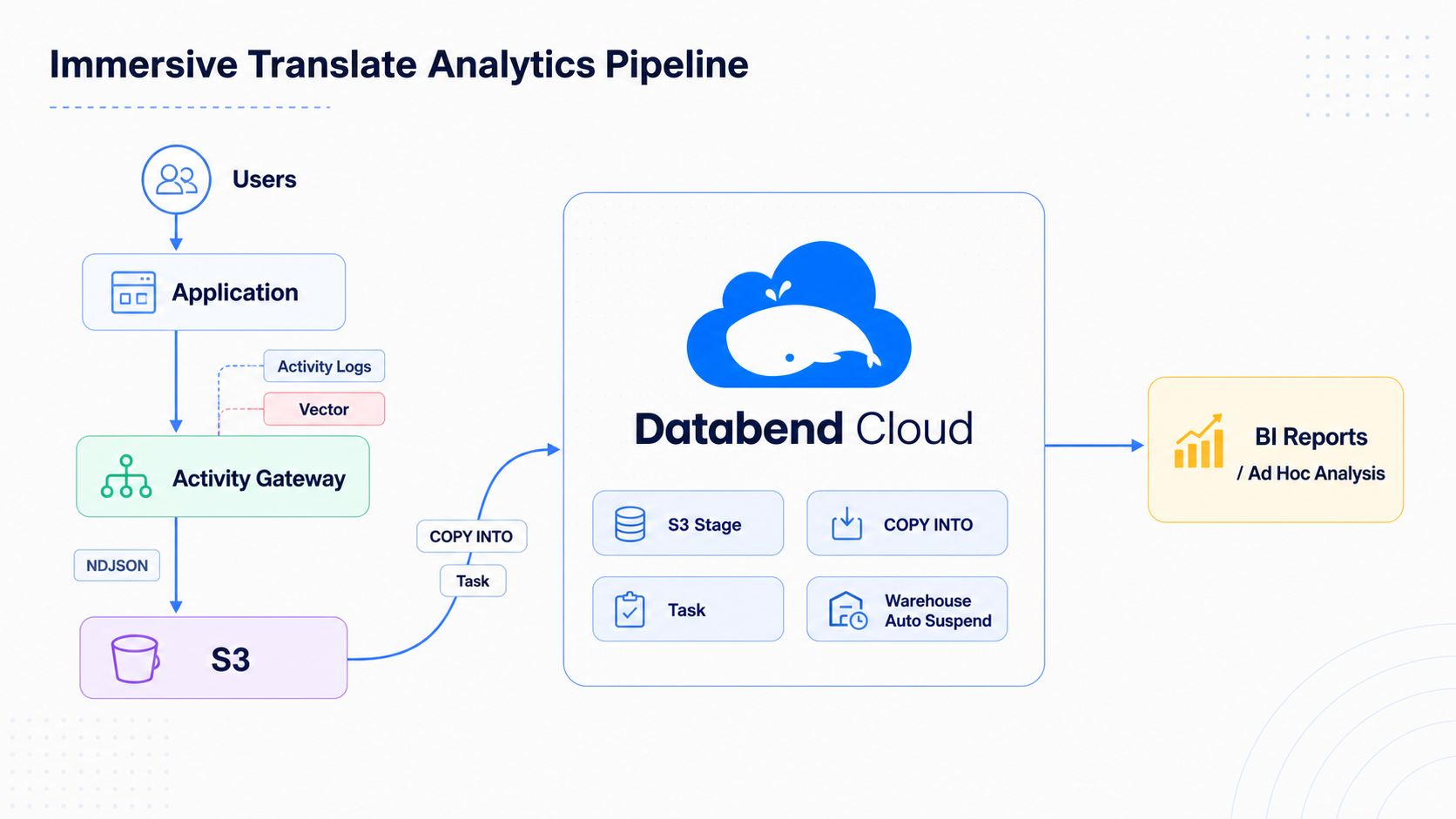
Instead of sending analytics logs through Kafka, the team writes business event logs as NDJSON files to S3. Databend Cloud then treats S3 as an external stage, ingests the data through scheduled tasks, and makes it available for SQL analysis and BI dashboards.
The architecture is intentionally simple:
-
Product events are collected with a lightweight schema.
-
Logs are written to S3 in NDJSON format.
-
Databend Cloud reads from the S3 stage.
-
A scheduled task loads data into Databend Cloud automatically.
-
BI dashboards and ad hoc SQL queries run on elastic warehouses.
This removed the need for Kafka, Spark, Hive, and a separate orchestration layer for this workload.
Why Databend Cloud Fit the Use Case
Databend Cloud matched the team’s requirements in several ways.
It is S3-native and built around a storage-compute separated architecture, helping reduce storage cost while keeping compute elastic.
It supports standard SQL, which allows the team to move beyond fixed dashboards and run flexible product analysis.
It supports semi-structured data, including JSON, which is important for event logs that may evolve over time.
It provides scheduled Tasks, so the ingestion workflow can run inside the warehouse without maintaining a separate scheduler.
Its warehouse model supports auto-suspend, which means compute does not need to stay running when no queries are being executed.
Databend also provides Time Travel, giving the team a way to recover or inspect data at previous points in time.
The Result: A Smaller Stack With More Analytical Freedom
With Databend Cloud, Immersive Translate was able to replace a complex analytics architecture with a much leaner pipeline centered on object storage and SQL.
According to the original case study, the team completed the POC in one afternoon.
The benefits were practical:
-
No Kafka layer for this analytics workload
-
Lower operational complexity
-
More predictable storage and compute cost
-
SQL access for flexible analysis
-
Support for both BI dashboards and ad hoc queries
-
Better control over collection scope, storage choices, and future deployment options
For Immersive Translate, the value was not only performance. It was the ability to keep the data architecture simple while still preserving analytical depth.
What This Means for Modern AI Products
AI-native products often grow with messy, high-volume operational data: logs, tool calls, latency records, provider responses, error events, and user-facing product signals.
Teams need to analyze this data quickly, but they also need control over cost, data architecture, and infrastructure complexity.
The Immersive Translate case shows a useful pattern:
Use object storage as the durable data layer. Keep ingestion simple. Query with SQL. Scale compute only when needed.
That is where Databend Cloud fits: a modern cloud native data warehouse for teams that want analytical flexibility without rebuilding a traditional big data stack.
Subscribe to our newsletter
Stay informed on feature releases, product roadmap, support, and cloud offerings!