
Databend product updates for August and September 2026: materialized views, data sharing, and lineage
 DatabendLabsOct 14, 2026
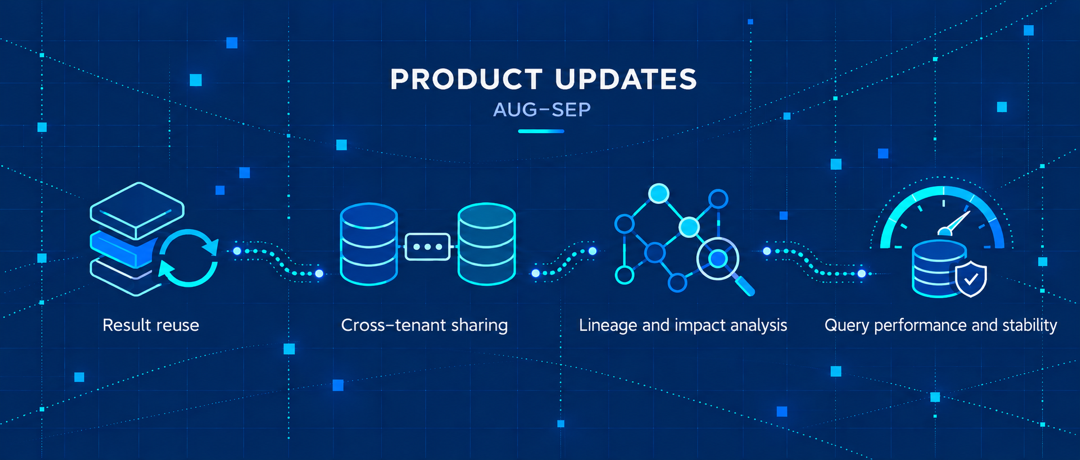
Databend's August and September 2026 updates address that workflow. Materialized views and Dynamic Tables add options for persisting reusable results. Data Sharing provides read-only access across tenants in the same Databend Meta cluster, including independent Stream consumption. Data lineage adds object-level and column-level dependency queries. The release also includes changes to partitioning, TopN execution, indexing, resource management, and query correctness.
This post is intended for data engineers and platform teams familiar with analytical SQL, views, change tracking, and incremental data processing.
Release snapshot
Across GitHub Releases, the Databend repository published 20 nightly releases, from
v1.2.931-nightly
v1.2.950-nightly
v1.2.925-patch-6
v1.2.925-patch-13
After deduplicating pull request entries by number, the nightly release notes contain 272 shipped changes.
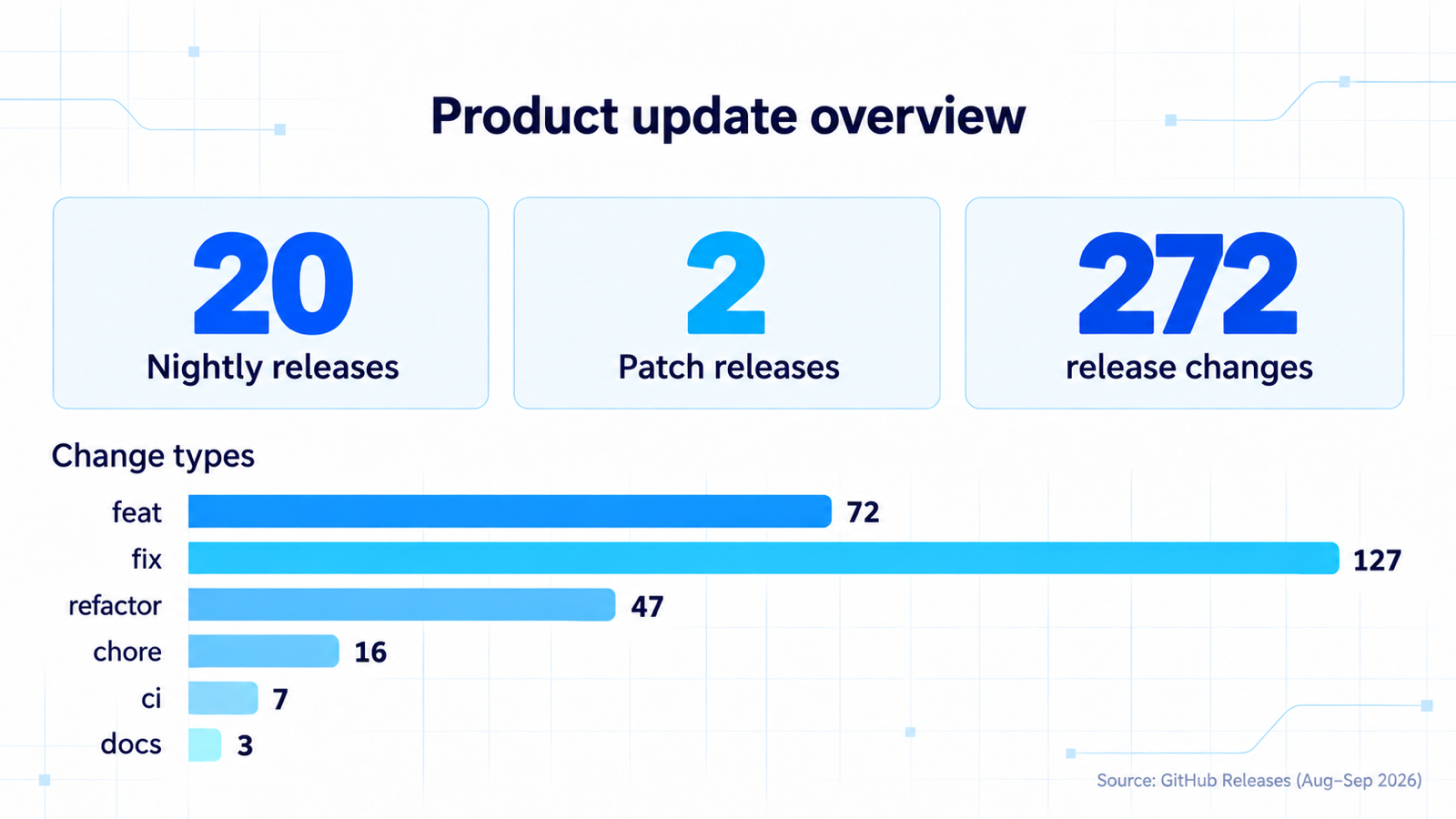
These figures describe changes included in published releases. They are not a count of pull requests merged during the same calendar period. The
feat
fix
Materialized views: reusing results with less repeated work
A materialized view persists query results or intermediate aggregate states. A regular view stores only the query definition; a materialized view also has to account for source changes, refresh behavior, read consistency, and query rewrite.
Change tracking and hybrid reads
Databend materialized views use
CHANGE_TRACKING
REFRESH MATERIALIZED VIEW
-
Appends support incremental refresh.
-
Non-aggregate materialized views use internal source row identifiers to process updates and deletes.
-
Aggregate materialized views store aggregate states and can merge existing states with states derived from appended data. Updates or deletes in the source may still require a full recomputation.
-
Hybrid Reads can combine persisted results with source-table increments that have not yet been refreshed in append-only workloads, reducing the need for a full source scan.
Query rewrite and maintenance
The optimizer now has materialized-view rewrite rules, an
enable_materialized_view_rewrite
Materialized views also support cluster keys, reclustering, compaction, indexes, and visibility through
system.materialized_views
The following example creates a category-level aggregate over an append-oriented sales table:
CREATE TABLE sales (
  category STRING,
  amount INT
) CHANGE_TRACKING = TRUE;

CREATE MATERIALIZED VIEW mv_sales (
  category,
  total_amount
)
CLUSTER BY (category)
AS
SELECT category, SUM(amount)
FROM sales
GROUP BY category;

REFRESH MATERIALIZED VIEW mv_sales;

SELECT * FROM mv_sales;
Materialized views are available in Databend Enterprise Edition and require the corresponding license. A materialized view currently uses one persisted Fuse table with
CHANGE_TRACKING
Controlling refresh work in batches
September added a batch-size hint for refresh operations:
REFRESH MATERIALIZED VIEW mv_sales LIMIT 100000;
LIMIT
UPDATE
DELETE
When a Dynamic Table is a better fit
This release adds Dynamic Tables with full refresh. A Dynamic Table uses a separate Fuse-based table engine and persists results derived from multiple tables.
REFRESH DYNAMIC TABLE
A query against a Dynamic Table reads the result of its most recent refresh, so the data may lag behind its sources. The current implementation does not include automatic scheduling, incremental refresh, or the freshness compensation available through materialized-view Hybrid Reads.
Use a materialized view for reusable single-table results and optimizer rewrites. A Dynamic Table fits multi-table derived results when an explicit full-refresh interval is acceptable.
Data Sharing丨live access across tenants
Data Sharing lets isolated tenants work from the provider's source data while keeping separate data-processing environments. In this context, a tenant is a Databend data and permission boundary. It may represent an independently managed business unit or a customer of a platform service.
Without Data Sharing, cross-tenant consumption often requires exports, copies, and synchronization jobs. A provider can instead add selected Fuse tables to a Share and grant access to a consumer tenant. The consumer creates a local read-only database binding and queries the shared objects without first copying the complete source table.
From provider authorization to consumer access
A Share exposes one database and selected Fuse tables within it. The provider controls the shared objects and tenant grants. The consumer accesses the data through a local database name. A Provider Connection resolves storage access without copying provider credentials into the consumer's database binding.
Replace
<provider_connection>
<consumer_tenant>
<provider_tenant>
-- Provider: create a Share and grant access to the database, table, and consumer
CREATE SHARE sales_share CONNECTION = <provider_connection>;
GRANT USAGE ON DATABASE sales TO SHARE sales_share;
GRANT SELECT ON TABLE sales.orders TO SHARE sales_share;
ALTER SHARE sales_share ADD ACCOUNTS = <consumer_tenant>;

-- Consumer: create a local read-only database binding
CREATE DATABASE shared_sales FROM SHARE <provider_tenant>.sales_share;
SELECT * FROM shared_sales.orders LIMIT 10;
The sharing relationship uses stable Share, database, and table IDs. Renaming an object preserves access to that object. Dropping a table and creating another table with the same name does not transfer the old grant. The provider can stop future access by revoking the table grant or removing the consumer account.
Independent Stream consumption
September also added consumer-local Streams on shared tables. Once the provider enables
CHANGE_TRACKING
Consumers can process the same shared business data on different schedules without sharing progress. A Stream records consumption state; it does not run the downstream synchronization or transformation job.
Scope and limitations
-
Sharing works across tenants in the same Databend Meta cluster. It does not connect arbitrary independent deployments across clusters.
-
A Share currently exposes selected Fuse tables. Consumers have read-only access and cannot modify the source table or reshare the database.
-
Provider tables with row-access or column-masking policies cannot currently be shared directly across tenants.
-
Streams require change tracking on the provider table. Dropping and recreating the consumer's shared database invalidates its existing Streams.
-
Data Sharing is an Enterprise Edition feature and requires the
license.DataSharing
Data lineage: tracing sources and downstream impact
Databend extracts object and column data flows from query plans, then aggregates successful query history to build lineage relationships. You can use the result to trace a dataset to its sources or inspect downstream dependencies before changing a table or column.
Two table functions provide access to the lineage graph:
-
traverses upstream sources or downstream consumers at object or column level, with a distance from one to five hops.GET_LINEAGE
-
returns directly connected objects and is useful when expanding a lineage graph one level at a time.GET_LINEAGE_NEIGHBORS
-- Find upstream objects for a result table
SELECT *
FROM get_lineage('default.analytics.sales_summary', 'TABLE', 'UPSTREAM', 3);

-- Find directly connected objects
SELECT *
FROM get_lineage_neighbors('default.analytics.sales_summary', 'TABLE');
Relationships use a consistent
source -> target
query_id
The release also adds lineage refresh for existing views, extraction from explicitly materialized CTEs, materialized-view lineage, and relationship capture from bound query plans.
Lineage collection and aggregation are asynchronous and best effort. Databend does not backfill history from before lineage was enabled, and failures in logging or history processing can leave gaps. The result should not be treated as a complete audit record. Column lineage tracks columns that contribute to output values; it does not include every column used only for filtering, joins, or sorting. Check the history-table configuration and the SystemHistory license before enabling the feature.
Scan and storage efficiency
Fuse partition layout
Fuse tables now support
PARTITION BY
You can add a partition definition to an existing unpartitioned table with
ALTER TABLE ... PARTITION BY (...)
Hash-distributed partition writes distribute partitioned writes by hash. Related fixes separate partition and clustering layouts and improve write merging.
TopN scan pruning
A fused TopN operator and runtime scan filters use the current sort boundary to filter data during scanning. The release also rechecks TopN boundaries while reading blocks, supports TopN pruning for typed virtual columns, and pushes down aggregate rank-limit boundaries.
These changes target ordered
LIMIT
Optimizer statistics now propagate column statistics through
UNION ALL
Full-text search and multidimensional clustering
-
Inverted indexes add a Japanese tokenizer.
-
Index data is built with data blocks. Index-segment merging can reuse tokenization work and reduce object-storage requests.
-
The ngram bloom index has a more efficient build path.
-
Hilbert clustering adds metadata, statistics, and reclustering support through the current implementation. The legacy implementation removed in the previous period is not retained.
-
Reclustering can run concurrent tasks and has lower coordination and diagnostic overhead for sort and merge work.
Reliability, governance, and operations
Cancellation and resource cleanup
Cancellation paths now interrupt synchronous spill processors and hash-join streams more reliably. Fixes cover task shutdown after a Flight exchange closes, hash-exchange blocking when a receiver exits early, and spill operations that remained blocked after downstream work completed. These cases occur when a client disconnects, a query is cancelled, or a consumer stops after reading only part of a result.
Memory use and execution correctness
Memory-related changes tighten the boundary at final aggregation, allow Window output to spill, remove unused columns before Window buffering, limit Parquet row-group bytes, allocate decode buffers by selected-row count, and stream Vacuum GC with root-node memory control.
Correctness fixes cover nullable correlated and lateral join keys, consistent distributed time functions, session time zones for Window
RANGE INTERVAL
Derived data and history lifecycle
Databend fixes correctness after change-tracking counters are reset and adds checks around materialized-view refresh and rewrite. Vacuum no longer removes active temporary tables or staging tables used by an in-progress CTAS operation. Time Travel now returns an explicit error when a requested snapshot is missing.
Testing now includes a type matrix, metamorphic testing, and a table-kind by write-path matrix, increasing coverage across data types, table engines, and write paths.
Row-level TTL metadata
The release adds DDL and metadata support for defining, changing, and removing row-level TTL expressions. Background scheduling and expired-row deletion are not included at this stage. Defining a TTL expression does not automatically delete expired data.
Meta communication, notifications, and tasks
Databend Meta adds a Raft protocol secret, compatibility-mode support, Raft peer TLS, and configurable gRPC handshake authentication. Multiple credentials can overlap during rotation. Meta administration tools now use
--user
--password-file
These options require certificate configuration, an authentication policy, and a planned upgrade order. Installing the new version does not automatically encrypt all Meta communication.
WEBHOOK_BODY_TEMPLATE
Task definitions can now parse constant
EXECUTE IMMEDIATE
Client ecosystem
databend-jdbc
v0.4.9
v0.4.10
v0.4.9
v0.4.10
bendsql
Where these updates fit
| Scenario | Features to evaluate | Expected value and boundary |
|---|---|---|
| Repeated queries and shared intermediate results | Materialized views for single-table results; Dynamic Tables for multi-table derived results | Reduce repeated scans and computation. Dynamic Tables use explicit full refresh and may lag behind their sources. |
| Cross-tenant data collaboration | Data Sharing with consumer-local Streams | Reduce exports, duplicate copies, and synchronization jobs within one Meta cluster. Consumers still need downstream processing tasks. |
| Incident tracing and change-impact analysis | Object-level and column-level lineage | Trace an unexpected metric to its sources and inspect affected downstream objects before a schema change. Lineage is best effort and is not a complete audit record. |
| Query efficiency and runtime stability | Fuse partitioning, TopN pruning, indexes, resource cleanup, and memory controls | Reduce scanning and improve cleanup under large queries, cancellation, and early client disconnects. Results depend on data layout and execution plans. |
Before adopting a feature, check the target Databend version, license, and documented limitations. Validate performance changes against production-shaped workloads.
Upgrade notes
This release period removes several capabilities. Check existing deployments for dependencies before upgrading:
-
Aggregating Index: Databend is moving this use case to materialized views. Reassess definitions, licensing, and refresh strategy. Existing indexes are not migrated automatically.
-
PROXY table engine: materialized views replace the previous direction for this capability.
-
Hive Catalog: the catalog is removed as use of Hive tables and the surrounding ecosystem has declined.
-
Lance unload support: historical metadata remains decodable for compatibility, but access to data in Lance format returns an unsupported error. Move affected workflows to a supported format.
-
Read-only
table engine: new table syntax is no longer supported, and existing tables using this engine fail after the upgrade.ENGINE = DELTA
Review the Release Notes for the target version, plan the required migrations, and run compatibility tests before upgrading.
Visit the Databend GitHub repository and Databend documentation for Release Notes, feature details, and usage guidance.
Subscribe to our newsletter
Stay informed on feature releases, product roadmap, support, and cloud offerings!