
 KKould
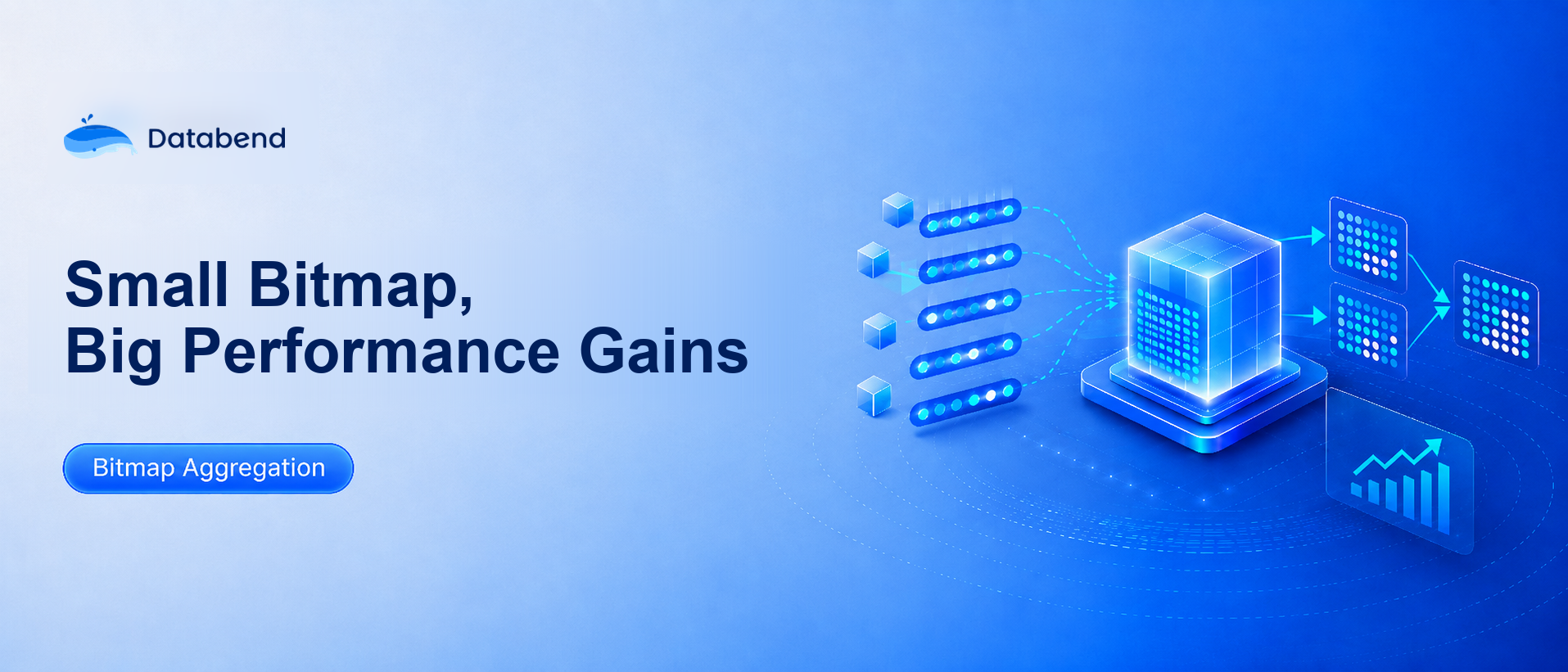
Bitmap functions are commonly used in SQL databases to represent sets efficiently and accelerate set operations. They are especially useful for high-dimensional filtering and exact deduplication at large scale. Databend already supports a broad set of bitmap functions. For usage details, see the Databend bitmap function documentation. ` In distributed aggregation, a typical bitmap workflow looks like this: read many small bitmaps from many rows, aggregate them layer by layer, and eventually produce a larger bitmap that contains the final union, intersection, or other set result.
For example:
SELECT bitmap_intersect(user_tags)
FROM events
WHERE dt = '...';
Before this optimization, the execution path for this type of query could be simplified as:
row bytes -> deserialize RoaringTreemap -> aggregate state operate -> result
There are two obvious cost centers in this path:
-
Bitmaps are usually stored as bytes. When a query touches many rows, deserializing every row into a full bitmap structure amplifies read and construction cost by row count. For bitmaps with only a few elements, it is better to compute directly on bytes or on a lightweight representation whenever possible.
-
When two bitmaps are combined, the engine should reuse existing structures as much as possible. Rebuilding bitmap objects on every operation creates extra allocations and temporary objects.
Databend Workloads That Benefit
This optimization is especially useful for the following Databend workloads:
-
User segmentation:
/bitmap_intersectacross different user tag groups.bitmap_union -
Behavioral analytics: computing sets for visits, clicks, purchases, and other events.
-
Funnel analysis: intersecting user sets across funnel steps.
-
Permission or resource set checks: quickly testing set containment or overlap.
-
Large-scale low-cardinality aggregation: many rows contain small bitmaps that are eventually merged into one result.
These workloads share the same shape: the number of input rows is large, but each row-level bitmap is small. If every row is expanded into a full
RoaringTreemap
The purpose of
HybridBitmap
RoaringTreemap
HybridBitmap: One Representation for Small and Large Sets
Bitmap functions are mostly used in aggregation, where data often follows this pattern:
many small row-level bitmaps -> gradually larger aggregate result
Databend therefore represents bitmaps with two structures:
-
: represents small sets withSmallBitmap, with low construction cost.smallvec
-
: represents large sets with Roaring Bitmap, which is well suited for compressed high-cardinality sets and set operations.RoaringTreemap
The state transition is straightforward:
SmallBitmap -> threshold exceeded -> RoaringTreemap
SmallBitmap: Lower Construction Cost for Small Sets
SmallBitmap
When modified,
SmallBitmap
Because
SmallBitmap
In some operations such as
xor
RoaringTreemap: Compression and Fast Operations for Large Sets
RoaringTreemap
Compressed bitmaps matter in database systems. Without compression, large row-level bitmaps can introduce heavy read and compute overhead.
There are other mature compressed bitmap formats, such as Oracle BBC, WAH, and EWAH. However, these formats do not support efficient random access. Computing an intersection may require fully decompressing a large bitmap.
Roaring Bitmap takes a different approach: it partitions data into multiple containers. This makes it fast to check whether a value exists, while still providing good compression ratio and set operation performance in many workloads.
The trade-off is that, compared with
SmallBitmap
RoaringTreemap
With this hybrid representation, Databend can choose the right structure at different stages of computation. For example, in a
bitmap_intersect
-
When reading row-level bitmaps, Databend keeps bytes in a small bitmap representation whenever possible.
-
During result computation, Databend switches to
only if the result grows.RoaringTreemap -
When one side is a
and the other side is a serialized small bitmap, Databend tries to compute the intersection directly from the small bitmap bytes instead of fully deserializing every row intoRoaringTreemap.RoaringTreemap
This reduces the read and construction cost of many small bitmaps, while preserving the performance benefits of
RoaringTreemap
Operation Matrix: Choosing the Right Computation Path
HybridBitmap
RoaringTreemap
RoaringTreemap
| Left state | Right state | Strategy |
|---|---|---|
| Small | Small | Perform set operations directly on sorted small vectors, avoiding |
| Small | Large | Promote to Large only when the operation requires it. For example, |
| Large | Small | Iterate over the small set and apply local operations on the Large bitmap, such as |
| Large | Large | Use native |
| Large | serialized small | Compute directly against serialized bytes when possible, reducing the cost of deserializing each small bitmap into a full |
In aggregation workloads, inputs are usually read from columns as bytes. If every small row-level bitmap is first deserialized into a full
RoaringTreemap
By separating the
small
large
serialized small
RoaringTreemap
Benchmark: Faster Small-Bitmap Aggregation
Because benchmark coverage, function naming, and later implementation details differ before and after PR 19041, this section only shows small-bitmap aggregation paths that can be reproduced and aligned between the two versions.
The
bitmap_intersect
bitmap_union
bitmap_intersect_empty
bitmap_union_disjoint
| Benchmark | Median before PR 19041 | Median after PR 19041 | Improvement |
|---|---|---|---|
| 15.27 ms | 4.729 ms | 69.0% |
| 1.609 s | 533.1 ms | 66.9% |
| 19.67 ms | 7.628 ms | 61.2% |
| 2.009 s | 831.9 ms | 58.6% |
| 11.81 ms | 4.197 ms | 64.5% |
| 122.9 ms | 41.56 ms | 66.2% |
| 36.61 ms | 7.236 ms | 80.2% |
| 345.5 ms | 84.98 ms | 75.4% |
These results cover several common paths: small bitmap intersection, union, fast convergence to an empty result, and disjoint union where the result keeps growing. The biggest gains appear when a large number of small bitmaps participate in aggregation.
Before the optimization, every row-level bitmap had to be deserialized into a full
RoaringTreemap
After the optimization,
SmallBitmap
RoaringTreemap
When This Optimization Helps Most
These benchmarks focus on aggregation over many small bitmaps. They do not imply the same speedup for every bitmap workload.
When input bitmaps or intermediate results quickly grow into large bitmaps, the bottleneck shifts back to large-set operations inside
RoaringTreemap
In other words,
HybridBitmap
Conclusion: Delay the Cost of Large Bitmaps
The bottleneck in bitmap aggregation does not always come from the set operation itself. Often, it comes from constructing a full large-set data structure too early for a very small set.
When many row-level small bitmaps participate in aggregation, deserialization, object construction, and memory allocation are all multiplied by row count. That can become a major part of query execution cost.
The core value of
HybridBitmap
RoaringTreemap
-
Use
while the bitmap is still small, keeping construction and allocation overhead low.SmallBitmap -
Switch to
only when the set actually grows, and then rely on its compression and large-set operation performance.RoaringTreemap
This optimization does not replace Roaring Bitmap. It avoids using Roaring Bitmap before it is needed.
The benchmark results show that the most visible gains come from aggregating many small bitmaps, such as
bitmap_intersect
bitmap_union
RoaringTreemap
This makes
HybridBitmap
For Databend, this optimization is not only about making a few bitmap functions faster.
In a cloud data warehouse, many query costs come from repeatedly constructing, deserializing, and allocating small objects.
HybridBitmap
For users, the result is lower CPU usage, fewer memory allocations, more stable aggregation performance, and better cost-performance in user profiling, tag analytics, funnel analysis, and similar workloads.
Subscribe to our newsletter
Stay informed on feature releases, product roadmap, support, and cloud offerings!